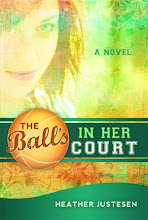
Alison got into the shower late. Mom was shopping, Dad was watching the younger kids. Ali heard the screaming, but she put it all down to Dad's roughhousing--until she stepped out of the bathroom and got the shock of her young life.
A year later, Ali and her mom are starting over--again. She hasn't yet recovered from the dark turn her life has taken, and doesn't know if she ever will. Then there's that pesky little detail--she's seen the face of a murderer and doesn't know if he will let her live long enough to graduate high school.
Honestly, all I did was take a shower today and this story hit me. What would this do to a young girl? How would she pull out of it? What are the immediate after-effects? By the time I get to bed tonight, I'll have a rough draft of the details all ironed out.
As if I don't have enough to do, writing-wise. Lately, my strong suit has been ideas. I've been getting them in spades--some good, others not so much--but they don't stop coming. I take notes and put them aside. If the story seems strong enough, I'll pick it up at a later date. There are some details that might change, but that standard life-or-death struggle is something that readers never seem to tire of.
What is your writing strength? Are you a plotter? A pantser? Do you love the idea stage, or the rough draft stage, but hate editing? Or are you one of those amazing people who loves the editing stage? Come on, don't be shy. :) Share!
Monday, October 24, 2011
The Girl
Friday, August 26, 2011
Story Structure: Ocean Waves or Stairsteps?
By Heather Justesen
I've spent quite a while mulling over one of my writing projects lately, trying to decide what wasn't working. Now don't get me wrong, the characters are terrific (if I do say so myself), the set up is good, the chemistry between all of the players is working nicely, but I still felt like something wasn't working quite right.
Then it hit me--I have plenty of conflict but it looks like ocean waves instead of a set of stairs.

You see, for conflict to push the characters to the end of the book, you have to keep upping the ante. Ocean wakes may have some nice crests, but the conflict comes back down again to a former level (or close).

Stair steps on the other hand keep building upward. One conflict stacks on top of the next until you reach the crisis at the end--and it keeps the reader riveted in their seats. If things don't continue to get worse for the character then the story stagnates.
Yeah, that means I need to do a little more tweaking to the story, but hopefully it'll help me make it the best it can be.
In other awesome news, I saw a preview of my book cover for my next book, Family by Design, and it rocks! Last I heard the book is supposed to be available in January, and seeing the cover has me all kinds of excited. I'll post it up here as soon as I get the final version.
Monday, October 25, 2010
The Wonders of the Human Mind
I had a great many writerly things going through my mind near the end of last week.
Sigh. I really should write these things down.
As a ponder the upcoming release of my first novel (less than 40 days now), my thoughts have turned to my newest project--the second book in the series. Since blogging about it previously, that book has changed. I cut THE WILD QUEEN completely from the trilogy, and am now moving forward with THE TYRANT KING. To complete the trilogy, I added THE LOST PRINCESS. I'm excited, since it promises to be an action packed story.
I worry less about plotting now. A lot of things have started to become second nature. The trouble is, when revisions come along, it's harder now for me to know what to do first. Thank goodness for writers' conferences, because I took heavy notes last time I sat in on a class about revisions.
This week, I'm actually holding a pre-sale booth at the Ben Franklin Academy fundraiser. Wish me luck! :)
Monday, November 2, 2009
The Six Word Novel
by Cindy Beck
As writers, we’re sometimes prone to descriptive sentences which too often need trimming, and there’s a great warm-up exercise to help with that. It’s called the “six word novel,” and the idea behind it is for the writer to create a story in just six words.
Not long ago, I asked my husband, Russ, a question as he sat in his recliner watching football with Corky Porky Pie, the dog. The only response I got was a grunt. I’m thinking the fact that the TV was turned up to level 40 on the volume might have had something to do with it. I hate to say it, but he’s almost deaf in one ear and can’t hear out of the other—a condition that I’m certain is the result of playing his stereo at full blast as a teenager. So, to express it in six words:
Music Loud
Time Fades
Hearing Aids!
Got the idea? Good. Here are a few more to get you in the groove.
First date
Home late
Wedding date
Magician fired—nothing up his sleeve!
Much Money
Stocks Fall
Soup Kitchen
Cat scratches baby. Cries. Fur coat.
Dog bone
Chew Chew
Bone gone
Sale:
Log cabin with bloodstained floor.
Computer on
Program freezes
Computer gone
Sale: Scuba tank with shark bite.
Now that you have the idea, give it a try. It’s a great way to get the creative juices flowing while having a little fun.
--
JUST A QUICK NOTE:
For those of you who are tracking what's happening with our book, Mormon Mishaps and Mischief, Nichole and I just received the proofs from our Cedar Fort editor, Heidi Doxey. We're so excited to be working with her, and looking forward to the book's release in December. Cedar Fort tells us the book will be in the CFI warehouse at the beginning of December and in the bookstores by the middle of the month. Think what a great Christmas gift Mormon Mishaps and Mischief will make for Aunt Persnickety and Uncle Lunkhead ... or anyone else on your Christmas list!
----

Friday, July 17, 2009
Plotting it Out
By Heather Justesen
I used to be what is commonly called a discovery writer. You know, you get an idea, play with it a bit (if you can stand to wait to start writing, which I sometimes couldn't) and then sit down and start typing. This is a great way to get a book started, and I know some people just let the story take them wherever it wants to go and end up with great stories.
Me, not so much.
I was writing for several years and had only finished one book from beginning to end...the other two dozen got anywhere from 30 pages to three-quarters of the way finished before I ran out of steam or lost the plot threads.
And then a couple of years back I learned I am much happier as a plotter. It's true, if I'm excited about what I'm writing and I have the major complications spelled out I can write a 90,000 word novel in under a month. The other bonus is that I can have it cleaned up and submitted in only five or six drafts, instead of twenty-five. Can I write a new novel every month? No, I'd probably go on burnout, and the edits would never get done, but I'm capable of writing that fast and with a decent first draft if i know where I'm going.
But despite that, I still let myself get moving on my current writing project (which was one of my three-quarters finished projects from a couple of years back) without plotting out that last quarter. And then as I got to the half-way point I started to flail.
Why wasn't it coming together? Why did I feel directionless and as though the story didn't want to be written?
And then I realized I hadn't plotted it out, and it all clicked.
Now, I'm not the type to write a thirty-page synopsis for a 300-page novel. If I did that, I would never end up writing the book--it's already been written, after all. Where's the fun in that?
Instead I open up my handy spread sheet and just put a sentence for the basics of what I plan to do in that scene. Each line is its own scene and I can easily cut and paste the lines as I shift around the storyline. It helps me keep track of my story arcs, to realize when I've gone too long since a certain thread was mentioned, or if my second character hasn't had a scene in his point of view for fifteen scenes.
Sometimes once I get started writing, I don't refer back to it very often. After all, the characters have wills of their own, and sometimes things happen in different orders than you expected, or a character decides to do something you had never planned. This leaves me with enough room to change things up and go with the story the way it wants to be written, but when I get frustrated and start feeling lost, I can refer back to the original plan and realize what I still need to cover to reach my happy ending.
Writer's bock? Not anymore!


 Posts
Posts