Here at my house, things tend to break down. A lot.
This is due primarily to the fact that much of our stuff is old and currently without hope of replacement. Yes, there is a financial component to this situation, but the truth is even if we could afford to replace this stuff, there are other factors at work.
Which is why there has been a new dishwasher sitting unused in our garage for two years while the old one rattles and leaks its way through every load. But that's another story for another blog post.
So with equipment in constant need of repair and limited funds to hire out the work, I have been required to call up my handyman genes and figure out the secret workings of washers and dryers and aerobic septic systems. But this hasn't always been easy.
Back in my grandparents' era, equipment was built with access and repair in mind. The workings were generally laid out in a way that invited understanding and tinkering.
These days, equipment is presented to the user as a "black box," where the inner mechanics are hidden behind a sleek exterior, often without screws, bolts, or any other obvious points of access. Things are just supposed to work, and when they don't you throw them away and buy a new one.
 Fortunately, these days also present us with a treasure trove of information, and if one is willing to do a little research and put in some effort, the hidden clasps and secret access points can be discovered, and even someone like me can replace a washing machine snubber or repair a compressor motor. The information is all there--we simply need to access it.
One thing I have learned is that no matter how complicated or intricate a machine or device is, there is a system to the way it works. It's rare that I get step-by-step instructions for the exact project I'm working on, so I have to use my knowledge of the system to create my own repair plan. Understanding that system demystifies the process, and allows me the confidence to move forward with the repair. Usually all it takes is a few hours, some band-aids, and two bars of soap (one for washing off the grease, and the other for washing out the mouth).
The same has been true with writing and publishing. There is a system to this process, and the secret to success is in the understanding of it. And yet, within the system there are so many variables that it's impossible to follow a preset course. The best any one of us can hope to do is learn enough about the system--the mechanics of story structure; the quality of voice; the tricks of dialog and characterization; the quirks and idiosyncrasies of publishing and selling--and then push forward with a plan of attack custom made for our own unique projects.
Fortunately, the information is all readily available on blogs, websites, twitter chats, and at writing conferences. We live in a day and age where the publishing world is much more complicated than ever before. And yet the information we have at our disposal is the best it has ever been.
Study, learn, and understand the system. Then bring out your band-aids and your soap, and get to work.
Monday, August 15, 2011
Mr. Fixit Learns The System
Friday, March 12, 2010
Running down the home stretch
By Heather Justesen
Today I've been working on galleys for my second book, Rebound, which is slated for release in early May. Galleys are the final edit before the book actually goes to print--the final little detail edit, not time to change things wholesale. Everything's been type set and the little dingbats have been put in place, and I've been loving my story again.
You know, it's funny, by the time I submit a book I'm so sick of looking at it I can't stand to give it another look, but after working on a couple of other projects, and getting some perspective, I'm really enjoying my next read through the story, catching the nuances I forgot that I added into the scenes and reading the little hints of attraction between my male and female characters--and they work! It's such a relief to look at it now and see that it's all working and yes, the book really is good enough I can be proud of it.
I'm going to tell you a secret--writers are some of the more neurotic, insecure people I know. We all have moments when we think that everything we're writing is trash. Or days when we've submitted a new manuscript and sit on pins and needles thinking that, yeah, our other published book(s) were pretty good, but surely the publisher is going to HATE this one--no matter how much we sweated over it and picked apart every little detail and plot twist until it was perfect. (And I'm so not just talking about me here--I've heard Whitney winners express this same feeling.)
So when I see my finished product (or close enough) and I'm enjoying the story, and I'm hardly finding any problems with it (One very noticeable mistake--if you're more into Utah basketball than I am, but hey, we caught it so I won't have to be horribly embarrassed when someone emails me and says that I got it wrong.) And I can't wait to see the cover and have my book on the shelves and be able to share it with everyone.
Do you get the feeling that I'm excited?
When I post here again in two weeks I'll have my cover and back-liner copy and I can hardly wait to share them with you!
Friday, September 25, 2009
Cover art and how to finish a book
By Heather Justesen
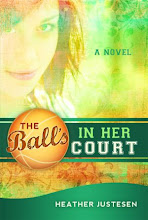
First, you may have noticed my new book cover in the column on  the side, but in case you didn't, or haven't seen it on my regular blog, or my website, or Facebook profile or any of the multitude of forums I belong to (I'm not at all excited, in case you couldn't tell), here it is.
Last week I received an email from a friend who is an aspiring writer. I've read the first three chapters of her book, so I know the girl can seriously write so I was surprised when she asked me this:
Okay, I'm feeling totally overwhelmed. How do you keep at a book when it seems like you're looking at a decade of work?
The problem? She kept going back to revise the previous chapters instead of focusing on getting the book written to the end. So this is what I told her.
I’m going to give you an assignment. Write the book—you are NOT allowed to go back and edit ANYTHING. If you realize in chapter 22 that you need to go back and change something in chapter 6 then make a note and keep plowing on (unless you’re going to add a scene, that is permissible. Editing the scenes around it while you’re at it is not). If you edit each chapter into perfection before you allow yourself to keep writing, it won’t get finished. This is your first draft—you’re going to have to rewrite it anyway to add or arrange for things you don’t know are going to happen yet. Wait until later, then edit the whole thing at once when it’s DONE.
The book I’m working on now I’ve worked on a chapter at a time. I take the chapter to critique, mark their notes on it, then keep writing. I haven’t made any significant changes to it, or read it through, just made notes on the text. When I finish getting the whole thing through my critique group, I’ll go back and do my editing. And I can see piles of things that I did wrong, or that I should tweak to reflect the direction my book is going now, but I don’t give myself permission to work on those until the last chapter is written, or the end will never get finished.
Try it and see what happens. It’s too easy to get distracted with everything you did wrong earlier in the book and let that stop you from moving forward. It’s much easier to fix the book when it’s done, even though I know that seems daunting. Trust me, I hate doing full edits, especially when there’s a significant amount of reworking that has to be done. I drag my feet and procrastinate for months. I’ve looked at piles of manuscript that are covered in red ink and think it’s going to take me FOREVER to fix all of the problems my friends pointed out. Strangely, it’s never as bad as my mind makes it out to be. Usually, I finish it much faster and less painfully than I expected.
Go for it!
Yesterday at the Book Academy conference at UVU Brandon Sanderson was a key note speaker. He spoke about the ten things he had to learn before he got published. (If anyone got the title for #4, please let me know, I seem to have missed that slide). During the speech he talked about the difference between discovery writers (AKA seat-of-your-pants or 'pantsers') which he referred to as multi-drafters, verses single-drafters or plotters. He talked about the different methods, and how he uses different ones for different books, and--here's my point (yes, I do have one). He said multidrafters often have trouble finishing books because they don't have the ending planned, while single-drafters (a mis-nomer, of course, because even those who plot excessively have to edit their first drafts and revise--and they HATE to revise) tend to have trouble in the middle (and now I know why I struggle so much when I'm 60% done).
Understanding what kind of writer you are can help you avoid the pitfalls of never finishing your books so you don't have 13 on your hard drive that are nearly done (again, using me as an example. Well, 13 may not be exact, I haven't counted lately). Whatever your tendency, figure out what's holding you back and get the book finished. As Nora Roberts is commonly quoted: "You can't fix a blank page."
Monday, July 27, 2009
What's Jane Doing?
This weekend I watched the movie, “Becoming Jane,” which is based on the life of author, Jane Austen. In a particular scene, Jane is inspired by something that’s said and excuses herself mid-conversation to go write down the words. As she sits and pulls out her lead and paper, the woman—a ‘Lady’ of wealth—and man—the wealthy woman’s nephew—with whom Jane had been conversing have a small exchange that goes something like this:

Lady: “What’s she doing?”
Nephew: “Writing.”
Lady: “Can anything be done about it?”
Nephew grins and shrugs.
While watching this show, I had to laugh at the situation because it is such a spot on scenario in my own life. It truly can’t be helped, and my answer to the ‘Lady’ is, no, nothing can be done about it.
As authors and writers, we often tend to take in fine points of conversations and surroundings that others easily dismiss. These are the words and details that usually end up in our stories or other writing.
Is it because we’re hyper-aware? Or because we pay closer attention to the details of life? Maybe both. Or maybe our brains are constantly on overdrive as we do our best to go through life thinking around and through the voices in our head. Because for some of us, those voices are always there, and often loudest when we’re trying to close down and have a quiet moment. They hound us as we sleep at night, as we sit in church meetings, drive in our cars, sit on our back porch enjoying the family, during vacations, and sometimes as we attempt to meditate.
So when you ask yourself (or when someone else asks you) “Can anything be done about it?” here’s a possible solution: don’t ignore inspiration. Pull out your handy-dandy notebook (which you should always have nearby) and use it as a filter. By writing down the random lines, thoughts, and impressions as often as they come, we can better pay attention to other things going on around us.
Inspiration can be a terrible inconvenience—and it may take some training, but we can teach ourselves to keep those precious moments of clarity while still continuing through our daily lives with work, family, friends, and other obligations. We don’t have to give up one for the other. Instead, we simply learn how best to capture those moments while we continue to be present in the here and now.
And when you stop mid-conversation to snag a pen and write a few lines on your hand, your relatives and friends will eventually stop asking, “What’s she doing?”
They’ll automatically know you’re writing and that it’s okay. You’ll write down one or two lines, and jump right back into visiting.
Such is the life and reputation of a writer. And personally, I think it’s grand.
Monday, July 20, 2009
So You Want to Write a Book
Guess what? You’re not alone. According to some surveys, 80 percent of the
Well, if you’re one of those 80 percent, then how do you get from wanting to actually writing a book? Drum Roll… The first step is to have a good idea.
Stay with me here. I am betting that a good chunk of people wanting to write a book don’t actually know what they want to write a book about. You know, you just have this nebulous idea that writing a book about . . . well, something . . . would be really cool. You first need to figure out what that “something” is. So let’s delve a little into the realm of ideas.
How do authors get their ideas?
The answer to this is as varied as authors themselves. I get my ideas for non-fiction because of a need in my own life which I notice isn’t addressed very well. For example, I wrote Parenting the Ephraim’s Child because of what I couldn’t find in other parenting books. Think of a book that you would like to read but haven’t been able to find, then write it.
Believe it or not, I have way more fiction ideas than non-fiction ideas. I have a notebook full of story ideas, and these story ideas have come in many different ways.
It may be that I see a news article or hear about something, and think what if. For example, in today’s headlines is the story “Boy Once Confined to Bubble Emerges Seemingly Healed.” A 7 year-old boy who has a genetic mutation called NEMO (what endless title possibilities!) finally emerges from his bubble. This could be a great coming-of-age story. Or what about a fantasy where not only does the genetic mutation cause immune problems, but maybe superpowers too? Or this could be a story from the parents’ point of view. What would it be like to be the mother of this child? How would it impact siblings?
Sometimes I’ll just have an idea for a dilemma. What if you had to pretend insanity to keep from being killed for political reasons, for example. Jodi Piccoult writes excellent dilemma books. One of my favorites, My Sister’s Keeper, is based on the dilemma of one child that has leukemia and parents that have another child to be a matched donor for the first.
You can even take a story and think how you could twist it in a completely different way. Fractured fairy tales like Robin McKinley writes—Spindles End (Sleeping Beauty), Beauty (Beauty and the Beast), and Rose Daughter (another retelling of Beauty and the Beast)—are great examples of this.
The book I am currently working on originally stemmed from a story I told my son on a rainy day to keep him entertained. He asked to be told the story again and again. The idea then morphed when I heard of the title for another book and decided to do a little research. I have combined both ideas into my current project.
I get many ideas from music. Not the lyrics of music, but the feel of a song. The idea for the next book I’m going to write, in fact, popped almost complete into my head while listening to a song in the car one day. I can’t listen to that song when writing anything else, because it belongs to that one book. And when I start writing it, all I have to do to get in the right mood is play that song.
So, there you go. A few ideas on how to get ideas. I’m sure there are many other ways and I would love for anyone to share other ways they get ideas. The point is, ideas are everywhere, and if you’re a writer at heart, you will find them.
Thursday, July 9, 2009
Tips for adding humor to your writing
You’ve seen it in movies. You’ve seen it in books. You’ve seen it everywhere and perhaps never noticed it. It’s a humor device called “Irony” and it’s one trick that authors use to make their characters and plot lines interesting and funny. Irony is, to quote Webster’s, “a method of humorous or subtly sarcastic expression in which the intended meaning of the words used is the direct opposite of their usual sense,” for example, when someone calls a stupid plan, “clever.” That is considered irony.
When used subtly, irony can make your work more saleable, because it makes the characters more interesting and fun to read about. It makes the characters more likeable because it gives them a fault that people can relate to. Who hasn’t thought of himself as something he is really not? It also gives your work more depth. An example from my recent reading is Jonathon Stroud’s Bartimeaus Series. His genie talks like an all powerful, ferocious, intimidating, godlike creature, when all his actions indicate that he is cowardly, and not as strong or smart as he thinks he is. This makes for some hilarious and clever situations that are very fun to read about. Another example from a very popular work is Diary of a Wimpy Kid. The “wimpy kid’s” dialogue is laced with irony, making us laugh and fall in love with the character. Even the Berenstein Bears has irony. The Papa Bear is always setting himself up as an expert and he is really klutzy and not very knowledgeable. In the movie, “G-Force,” a dainty, sweet little girl tells someone if they try to put a bow in her hair they will lose a finger. This is funny.
You’ll notice irony everywhere in popular fiction and movies because it makes fiction and movies popular, and it makes the author seem clever. One caution though. It can be overused, and then it makes the author look like he is trying too hard to be funny or sarcastic.
To add irony to your work, take a good look at your character. Is he a body guard? What would be the last thing a buff and burly dude would say or do? You need to surprise your audience. Make him a germaphobe who loves decorating, or have him love something sweet and cute. In the Amelia Peabody series by Elizabeth Peters, the very intelligent and mature sounding boy uses his intelligence to invent things that cause all sorts of hilarious trouble for everyone, making us realize he is not as grown up as he thinks he is. This is the type of interesting character that leaves readers clamoring for more. Author Janette Rallison has made a name for herself lacing her character’s dialogue with irony to make what they say humorous and clever. Read some of her books to study how she does it. As you study other authors who use this device it will begin to make sense to you and you will become an expert yourself.
Kersten Campbell, author of "Confessions of a Completely Insane Mother"
humor blog: www.kersten4.blogspot.com
website: www.kerstencampbell.com
Friday, July 3, 2009
So much to do after the first draft
By Heather Justesen
It's been a busy but exciting couple of weeks for me. Cedar Fort has agreed to publish my second book, "Rebound." I finally got my third book out for a final round of critiques so I can get it polished and submitted this fall. I also have made some headway on publicity for my first book.
Does it sound a little crazy? Yeah, it can be, but I tend to like crazy.
One thing I never thought about when I started writing was how much work went in once the book was finally finished. First there are edits--and for some of my earlier books, the edits have been 20+ as I learned what worked and what didn't. Thankfully, I've learned a lot about writing since then, so I don't go through quite as many versions, but getting things right takes a bit of time and tweaking.
Second, I send my book into at least two rounds of critiques from other writers. Now that I've joined a weekly critique group with several other bloggers on this site, they are my first line against stupidity. One of the major advantages to having a supportive, honest, trustworthy critique group is that I have to have a chapter to take with me each week. That means I have to keep writing--even if it's only a few pages.
After my group, there are edits and corrections, polishing and tweaking, and then it goes out to more writers for critiques. This one is a full-manuscript critique. Since my weekly group takes five or six months--or more--to complete a book, there's a big loss of continuity. When you're reading that final scene, it's hard to remember what happened at the beginning. My final round of critiques helps me fix flow problems and continuity issues along with catching the problems I edited into the book in later versions.
Then there are final edits and I get to submit. And then the wait begins. Thankfully, the two to three months Cedar Fort takes to review manuscripts is considerably less than some of the other publishers. Once I have a contract, I like to do one last round of edits because I'm a bit anal. This is a very light edit, just looking for the little typos I missed in my previous rounds of insanity, and a few sentence tweaks. Really, at this point there shouldn't be much I want to change. If the book isn't polished and very clean already, it's not ready to submit, so this is mostly for my peace of mind, not because there is much to do.
And then we get to start planning publicity--which is a whole other topic and I'm sure we could all spend the next several weeks discussing everything we've done or plan to do, things we've heard of others doing, and how they seemed to work. Regardless, expect to spend a grundle of time getting everything organized and contacting everyone you've ever met to let them know you have a book out because when the book is accepted, the real work is only half done.


 Posts